
Centerville City Directory Shelves
Centerville has no separate, uninterrupted city-directory series of its own. The historical route is regional: Dayton, Dayton-suburban, and countywide criss-cross volumes carry the load. Centerville was a town in 1830. It became a city in 1968. The directory trade of that era centered on Dayton. Scope checking becomes essential because of this. A volume can still be valuable when its title says Dayton. Its place list or introduction, though, must show that it actually reaches a Centerville address.
| Collection | Confirmed years | Where held | Access |
|---|---|---|---|
| Odell's Dayton Directory and Business Advertiser | 1850 | Morgan County Public Library index | Early regional lead for Centerville research; digitized index with page citations |
| Williams' Dayton City Directory | Catalog begins 1856? onward | Dayton Metro Library | Centerville researchers request the precise in-library volume |
| Dayton Suburban directory | 1956-59; selected 1962-93 years | Ohio Genealogical Society holdings | Verify Centerville scope in each edition |
| Dayton South and South Suburban directories | 2000-04, 2007-08, 2015; 2000 onward | Ohio Genealogical Society and Dayton Metro Library | Later Centerville leads, not automatic coverage |
| Haines Dayton City & Suburban Criss-cross | Dates not posted in the public catalog | Dayton Metro Library | Ask staff for a Centerville-fitting edition |
Treat the table as a shelf map rather than a promise that every volume lists every household. Ohio Genealogical Society holdings document Williams/Dayton runs for 1888-89, selected years from 1900-53, 1953-77, 1979-90, selected 1992-2008, 2010, and 2014-15. That makes the society a strong alternate stop when a desired Dayton volume is missing locally. For Centerville work, record the volume title along with its coverage years. This regional pattern is the central fact behind any careful Centerville residents directory search. Note: A directory title alone never proves Centerville coverage; the edition's own place list or introduction must establish that connection.
Centerville City Directories in Dayton
The 1850 Odell index is a useful early example. It stays Dayton-focused, so it should never be labeled universal Centerville coverage. The digitized Odell index returns a name, an occupation, residence or locality wording, and a page citation. For later years, the Dayton Metro Library Williams catalog record names Williams as a publisher. That record also notes title variants. That same Williams catalog record anchors the in-library title trail. Centerville researchers should let each physical volume establish its own geographic reach.
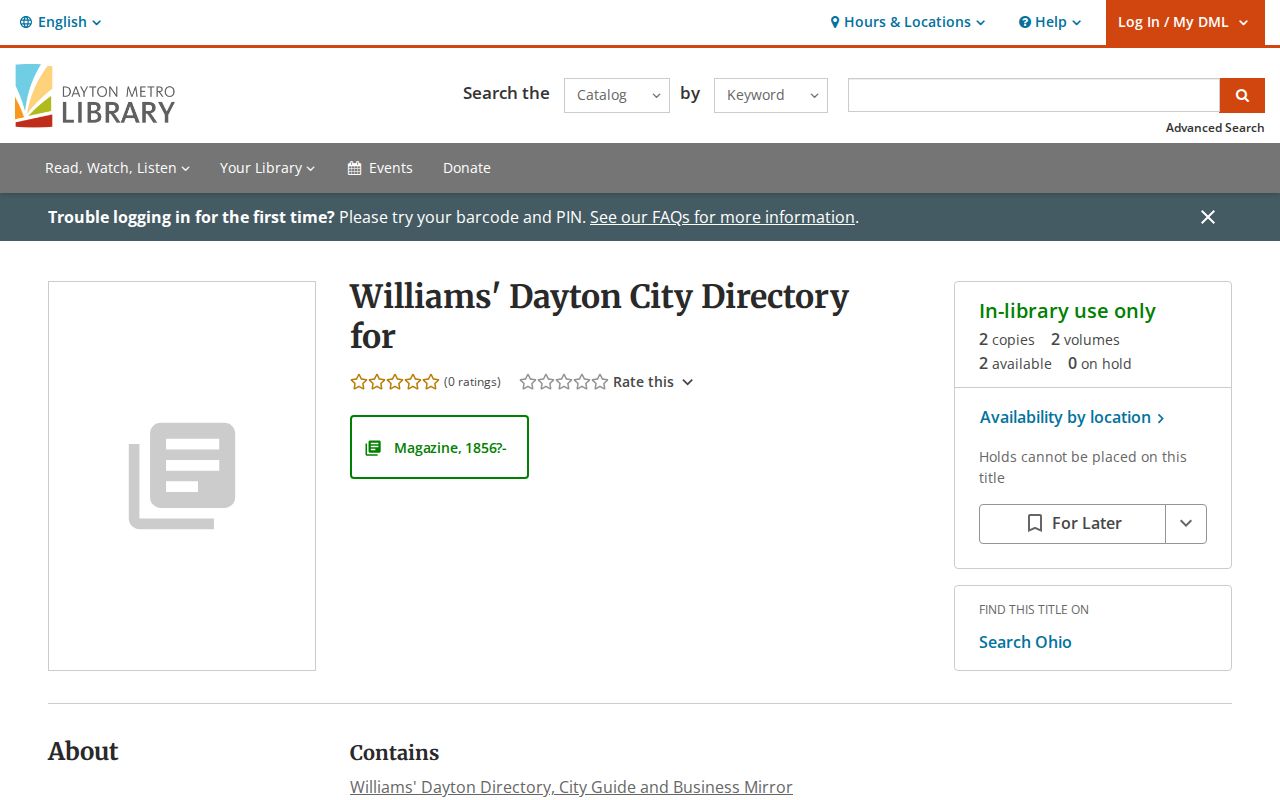
Use the catalog as a request lead, then read the actual volume's place list and introduction before crediting it with Centerville coverage. Here is the Odell directory index used for the 1850 trail. It shows why a citation matters as much as a name hit.
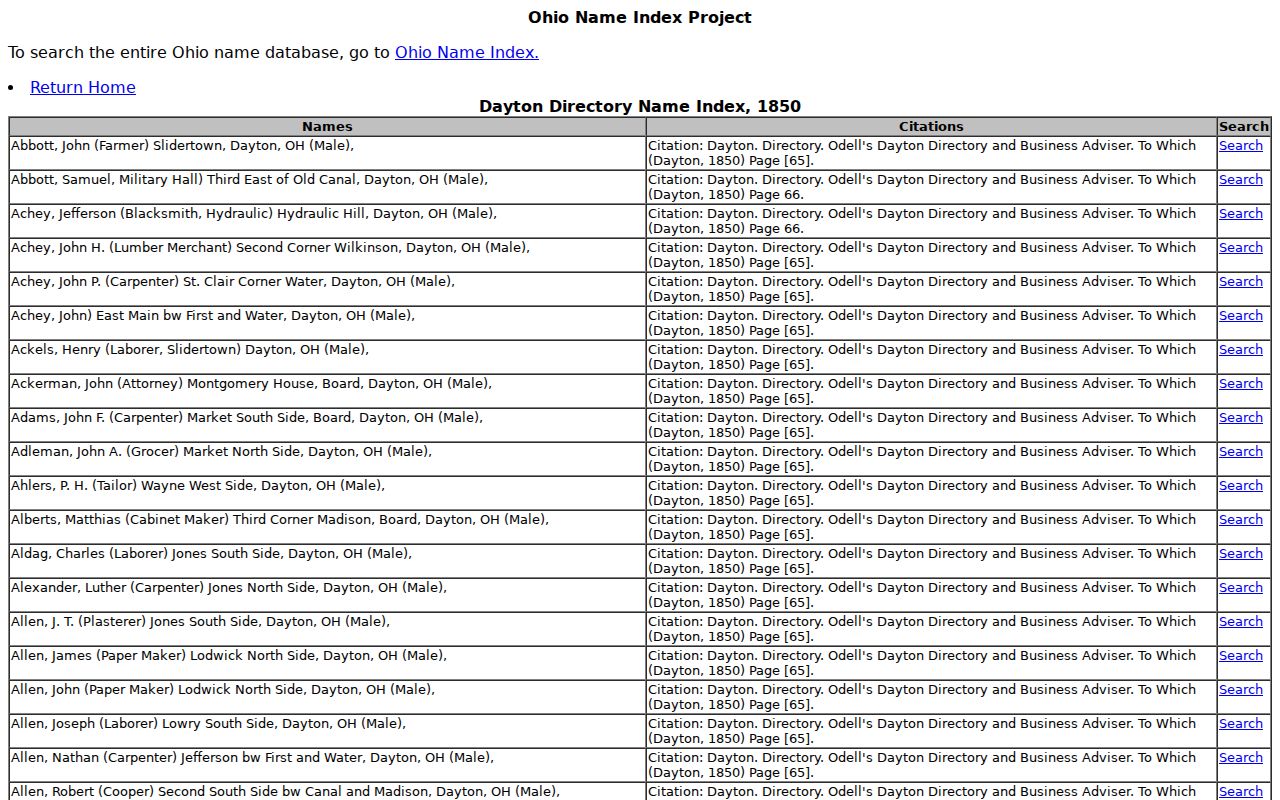
Save the page reference and edition year with every result. Those details let any reader return to the entry. Any reader can then judge whether its locality language supports a Centerville connection. Dayton directory microfilm for 1929-31 also appears in the National Archives city-directory guide. Treat it as a backup route for selected years. Do not treat it as proof of a complete local run. The best sequence is simple. Identify the edition first. Then inspect its front matter and entry, and state only what that edition shows.
Reading a Centerville City Directory Entry
A Centerville directory entry is a time-stamped editorial record, not an official population roll. The inspected Odell sample follows a pattern. Surname, given name, and occupation come first. Location, Dayton, Ohio, follows, and then a page citation. A Wright State-derived exhibition drawing on Williams volumes from 1914-15, 1925, 1934-35, and 1940 lists person name, residence or building and room number, occupation, and spouse. Those are the observed fields. It also preserves the abbreviation pages. Those keys matter for reading any entry correctly.
| Name | Use the printed Centerville form, then search spelling variants where needed. |
|---|---|
| Occupation | An observed field in the inspected Williams-based exhibition. |
| Residence or location | The address or locality wording belongs to that edition and date. |
| Spouse | Reported as an observed field in the Williams-based exhibition. |
| Page citation | Present in the inspected 1850 Odell index and needed for a retraceable Centerville result. |
- Criss-cross directory
- An address-to-name section, arranged to start with a location instead of a surname.
- Householder index
- An index organized around the household listing, useful only as the edition presents it.
- Abbreviation key
- The volume's own explanation of shortened terms; read it before expanding a label.
No publicly inspected Centerville-area Williams or Haines scan establishes a universal ownership, household-status, or widow mark. Never import conventions from another city or edition. Read that exact book's key first. Treat an indexer's gender label in the Odell online index as an added label rather than a guaranteed printed field, since the printed page governs what the directory actually says.
Centerville City Directory Research Rooms
Washington-Centerville Public Library's genealogy guide offers the strongest local library route. Its in-library resources include Ancestry Library Edition, Fold3, HeritageQuest, MyHeritage Library Edition, African American Heritage, the Ohio Death Records Index, Newspapers.com Library Edition, and FamilySearch Affiliate Library access. A personal FamilySearch account is required for affiliate images. The guide also points to Sanborn maps. Its newspaper resource holds more than 3,000 historical newspapers from 1700-2000. Those Washington-Centerville genealogy resources name the local access channels. They serve directory companions and dated name work.
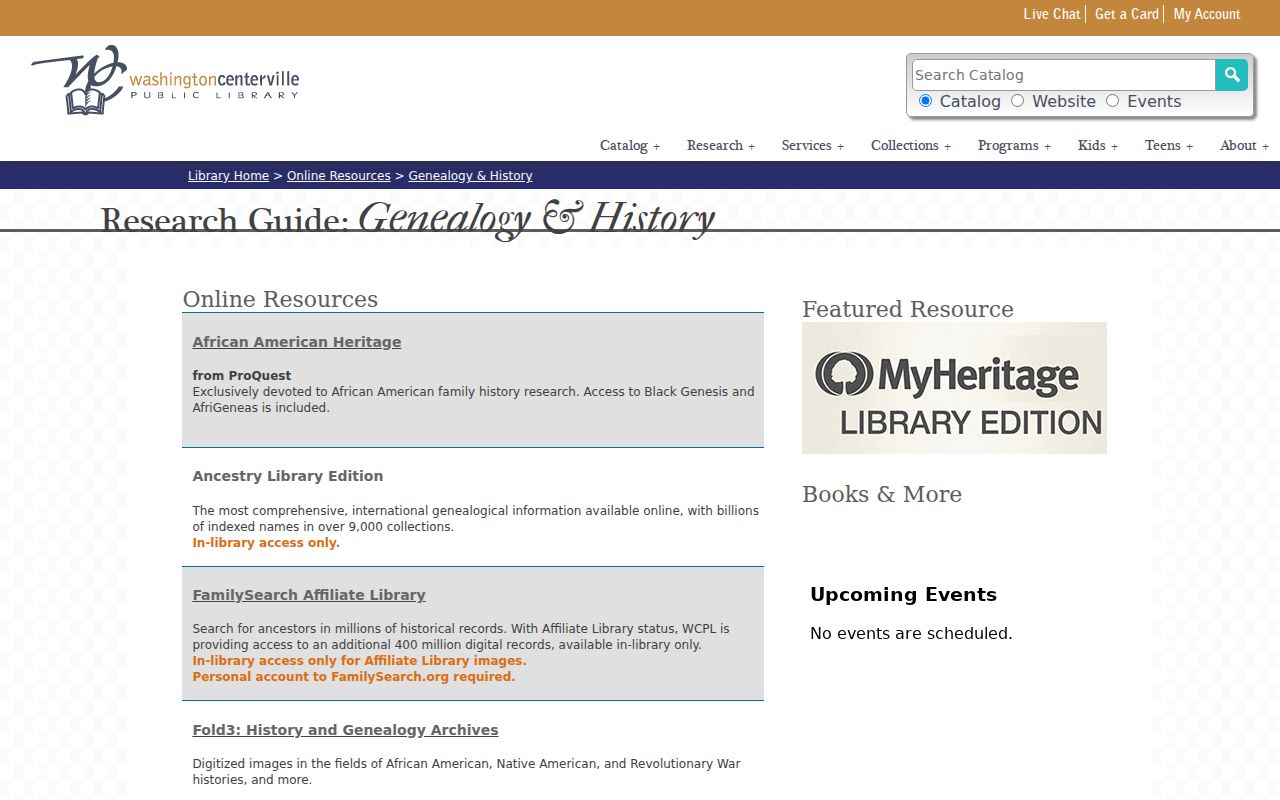
Need a hand with a specific lookup? The Centerville Reference Desk is 937-433-8091 ext. 2, and the Woodbourne Reference Desk is 937-435-3700 ext. 2. Library databases can also carry a Centerville directory name into newspapers, death indexing, or a census image. Each source still needs its own date and citation.
The Dayton Room at Dayton Metro Library is the other essential Centerville channel. It sits on the Main Library's second floor and holds more than 200 years of Dayton, Montgomery County, and Miami Valley material: books, photographs, maps, manuscripts, newspapers, and postcards. Open-stack genealogy shelves, microfilm scanners, Dayton Remembers images, in-library Ancestry, Ohio Memory, a death index, and Sanborn resources all come in handy when a Centerville directory hit needs context. Listed hours run Monday through Thursday, noon to 4 p.m., with other times by appointment. Contact 937-463-2665 or history@DaytonMetroLibrary.org.
For older county material, the formal Centerville fallback is the Montgomery County Records Center & Archives. Staff can pull requested items for inspection or copying through a computer-assisted index covering more than 47,000 locations. There is no general browsing shelf. RC&A is in the Reibold Building at 117 S. Main St., Dayton. It is listed weekdays from 8 a.m. to 5 p.m. Reach it at 937-225-6366 or recordscenter@mcohio.org.
Centerville Addresses in Haines
A surname directory answers one question. The Haines Dayton City & Suburban Criss-cross Directory answers another: which name did a given edition print at a Centerville address? Its public catalog covers Dayton, Montgomery County, and Greene County subjects but posts no dates. Ask Dayton Room staff to pull an edition. Confirm the desired Centerville address falls inside its coverage before trusting any address-to-name result. The Haines catalog entry is the request point for that address-first route.
Any Centerville criss-cross hit needs company. It needs the edition date plus a separate property or recorded-document source. That matters most for questions about a specific building. The address listing proves only that a printed entry existed, not that occupancy was uninterrupted.
Note: Keep the directory edition, page, and printed address with each Centerville result. That way the entry can be rechecked later.
Centerville City Directory Name Variants
When the Centerville directory trail goes quiet, Centerville-Washington History offers a family-file fallback. Its Local People resource points to physical files at the appointment-only Nutt Cottage Research Center. It also flags surname variants like Dunkin/Duncan/Dungan, Irwin/Irvin, Pierson/Pearson, Reese/Rees, Shreve/Sreve, and Voress/Vorhees. Try both spellings across Centerville directories, HOBITS, Recorder material, and estate indexes. Only then call a name absent. The Centerville-Washington History site is the source for that local-history route.
Nutt Cottage visits run by appointment through the curator at 937-312-0040. The society's headquarters sit at 89 W. Franklin St., Centerville, with a general phone of 937-433-0123. Its local Centerville publications can also add context for an early building or family when a standard directory falls short.
Centerville Directory Time Markers
Centerville directory evidence makes the most sense set against its era. Montgomery County and Washington Township both began in 1803. Centerville became a town in 1830 and a city in 1968. County historical holdings reach back to original-owner tract records for 1801-30, deeds from 1805, and tax duplicates from 1803. An early Centerville family often demands land and probate work before any directory title can help.
| 1801-30 | Original-owner tract records offer the earlier Centerville land trail. |
|---|---|
| 1850 | Odell supplies the first confirmed Centerville directory item in this research. |
| 1929-31 | Selected Dayton directory microfilm is a Centerville backup listed by the National Archives. |
| 1956-93 | Documented Dayton Suburban holdings provide several mid-century runs. |
| 1959-79 | The city's 2025 comprehensive plan identifies this as the dominant construction period for current neighborhoods. |
Those dates make a useful numbers check on a house-history search. Historic Uptown near Main and Franklin is a different matter. Its searches may call for tract, deed, church, cemetery, and older directory work. Later neighborhoods lean more on suburban-directory, property, permit, and recorded-deed evidence instead. The difference is about era. It is not a reason to force every Centerville address into one collection.
Trace a Centerville City Directory Household
Begin a Centerville surname-first search inside a named edition. Use the occupation, spouse, address, and abbreviation key to separate people who share a name. Then compare the directory year with a deed or tax year. Also compare it with the nearest federal census. Public population schedules reach 1950 under the 72-year restriction. A census household is one dated snapshot. A directory runs on another schedule. So a gap between them may be genuine.
- Locate the surname in a named volume and record the edition, page, spelling, address, and printed details.
- Check the next available edition, rather than assuming every year was published or held.
- Use a Haines criss-cross volume when an address-first question fits the edition's coverage.
- Compare a nearby census year with the directory date and keep both dates visible in the notes.
- Use deeds, obituaries, probate, or cemetery material to test a move, death, or ownership change.
HOBITS at Dayton Metro Library makes a strong endpoint. It indexes death notices and obituaries for 1850-80, 1897-98, 1900, 1903-18, 1920-39, 1951-57, 1965, and 1985 to the present. New entries are added daily. Results are citations, not full text. Request a copy by phone or email. Supply the full citation with each request. Keep copy requests to three at a time.
For a one-address trail, treat the directory result as one layer. The Centerville previous residents route follows the property's legal description and deed chain backward. These collections supply the printed household layer.
Centerville Directory Evidence Limits
A directory entry only proves what the printer set down in one edition. It can name a person, an occupation, a spouse, or an address. That is the limit. A listing does not show continuous residence. It does not prove current occupancy or ownership. Nor does it show that the person headed the only household at that address. When a name is missing, the cause could be a move. It could be an unlisted household member or a spelling change. A gap in the run of volumes, or an edition whose coverage skipped the place entirely, can also explain it. Match each finding to its printed page and weigh it accordingly.
Centerville and Washington Township are two governments. Residents treat them as one community across nearly 32 square miles. Because of that overlap, the same family can appear under several labels. It might carry a Centerville label or a Washington Township label. It might carry a Montgomery County label or a postal label instead. Record the exact wording from the source notes. Then compare an independent record before calling it a family connection. A deed or voter roll works well for this. Note: the strongest directory finding cites its edition, page, spelling, location wording, and the separate record used to confirm it.