
Centerville Resident Lookup Records
Centerville has no single official list of every person who lives in the city. The useful record changes with the question. The Montgomery County Auditor ties a parcel to tax and ownership fields. Recorder’s Information Search System, known as RISS, indexes parties to recorded documents. Ohio’s voter service can confirm the information it is permitted to return for an individual. Court and probate records identify people connected to public cases, while vital records document a particular event. Each route has a different scope, so a result should be described by what that record actually establishes.
| Record | What It Confirms | Where | Access |
|---|---|---|---|
| Auditor property record | Parcel, situs, ownership and possible tax-mailing contact | Montgomery County Property Search | Public property route; not household proof |
| Recorded instrument | A named party’s link to a deed, mortgage, lien, plat, or other filing | Montgomery County Recorder RISS | Party role and document type must be checked |
| Voter registration | Official elector information allowed by Ohio law | Ohio Voter Lookup | Time-specific and subject to protected fields |
| Court docket | Named party, court, case number, and visible case status | Montgomery County PRO | Restricted and sealed material remains unavailable |
| Probate or vital record | A public estate trail or qualifying life event | Probate Court or the appropriate vital-record issuer | Forms, fees, and statutory limits apply |
| License or entity filing | Credential status or business filing affiliation | Ohio eLicense or Ohio SOS | Not evidence of a residence |
Start with the Auditor when a known address is part of a property question. Start with RISS when a deed or recorded filing is the connection. For an estate, use the Probate Court route. A court or credential result can help separate two people with the same name, but it should not replace a second, date-compatible record.
Note: A reliable Centerville match identifies the record type, the person's role, and the date before it is compared with another source.
Centerville Address Match Caution
An owner name and a home address can look like a direct match, but the fields mean different things. The Auditor’s property result lists parcel ID, owner, and parcel location. Its detail record can show the property mailing address and ownership, and the most recent sale’s buyer is identified as the current owner in the official walkthrough. None of that proves that every owner, mail recipient, family member, or former party currently lives at the parcel.
The distinction matters in Centerville and Washington Township, which are separate governments commonly understood as one community. Preserve the parcel situs, the owner’s mailing address, and the date each was viewed. A mailing address may be outside Centerville and can change separately from title. That small recordkeeping habit prevents a property connection from becoming an unsupported claim about a household.
| Result field | Use it for | Do not treat it as |
|---|---|---|
| Parcel location | Identifying the taxed real property | A list of everyone at the address |
| Owner | Checking the ownership or tax record | Proof of current occupancy |
| Mailing address | Understanding tax correspondence | Proof that the recipient lives on the parcel |
| Deed reference | Opening the recorded title trail | A statement of family or household ties |
Note: Keep the physical parcel address and the tax mailing address as separate fields when checking a Centerville property result.
Verify a Centerville Resident Lookup
Use two independently created records to test a likely match. For a current property connection, the Auditor route can establish the parcel and listed owner. RISS then supplies a separately created document index. RISS By Name uses a required Last/Firm Name field, an optional First Name field, match choices of Begins With, Contains, and Exactly, plus Side One or Side Two options and an index-type selection. A narrow date range and the exact-match option are useful after a plausible party appears.
| RISS field | Type | Required | Centerville search note |
|---|---|---|---|
| Last/Firm Name | Text, up to 70 characters | Yes | Choose Begins With, Contains, or Exactly. |
| First Name | Text, up to 70 characters | No | Uses the same three match choices. |
| Side(s) | Dropdown | No | Both, One, or Two identifies the indexed side of a document. |
| Index Type | Multiple selection | Yes | Defaults include deeds, mortgages, partnerships, and UCC; service discharge is also available. |
| Start and End Date | Date fields | No | A bounded date range improves search time. |
| Sort Order | Dropdown | No | Match, file date, file number, or type, in ascending or descending order. |
- Record the full name, a likely date range, and the property or event question. Do not begin with a bare surname.
- Check the Auditor record when the question concerns a parcel. Keep the situs and mailing fields separate.
- Search RISS by name with a short date range. Open the relevant filing and confirm both the document type and the party’s role.
- Use a voter, court, probate, or vital route only for the separate fact that source can confirm. Compare dates before accepting a match.
- Ask the custodian for an allowed copy when an original record, a certification, or a missing period matters.
- Docket
- A court’s running case record, usually showing the case number, parties, filings, and visible status.
- Index and image
- An index points to a record. An image is the scanned document or document page, when the custodian makes one available.
- Certified copy
- A copy issued by the record holder with its certification, used when an official copy rather than an online display is needed.
Centerville Lookup Range Numbers
Portal numbers are useful limits, not proof that a record does not exist. PRO returns its first 1,000 records only. RISS has a separate pre-1980 path with displayed years from 1971 through 1979 and numeric pre-1980 number fields. Its Book/Page screen also offers scanned deed books numbered 1135 through 2541 and scanned mortgage books numbered 1691 through 2879. Those are the displayed online paths, not a promise that every older Montgomery County filing has a searchable image.
When a reference points beyond the web result, use the Recorder counter at 451 W. Third St., Dayton, or contact the Recorder at 937-225-4275. The Montgomery County Records Center & Archives is the historical fallback for material outside a portal’s practical range. Its computerized index reaches more than 47,000 locations, and records can be inspected or copied in its research area. A no-result should trigger a check of the period and custodian, not an assertion that a Centerville resident was never connected to the record.
Centerville Resident Court Checks
Court searches answer a case question, not a general identity question. Montgomery County Clerk’s Public Records Online, or PRO v3, covers listed municipal, Common Pleas General Division, Domestic Relations, and Second District Court of Appeals matters. Its General Search offers case number, last name, first name, company name, ticket number, case type, action type, and begin or end date. The service returns its first 1,000 records only. It reports that documents are normally available after 48 to 72 hours, while redaction, confidentiality, protection-order, and technical limits can restrict online material.
A visible hit can provide a court, case number, party format, and date to take back to the right clerk. It cannot reveal sealed, expunged, juvenile, protected domestic-relations, or Rule 45-restricted material. The Clerk’s Records Section accepts in-person, mail, and email requests at 41 N. Perry St., Room 104, Dayton, and lists regular copies at $0.10 per page and certified copies at $1 per page. Confirm the needed file and current process before ordering.
Ohio DRC’s Offender Search is a separate, status-specific state tool.
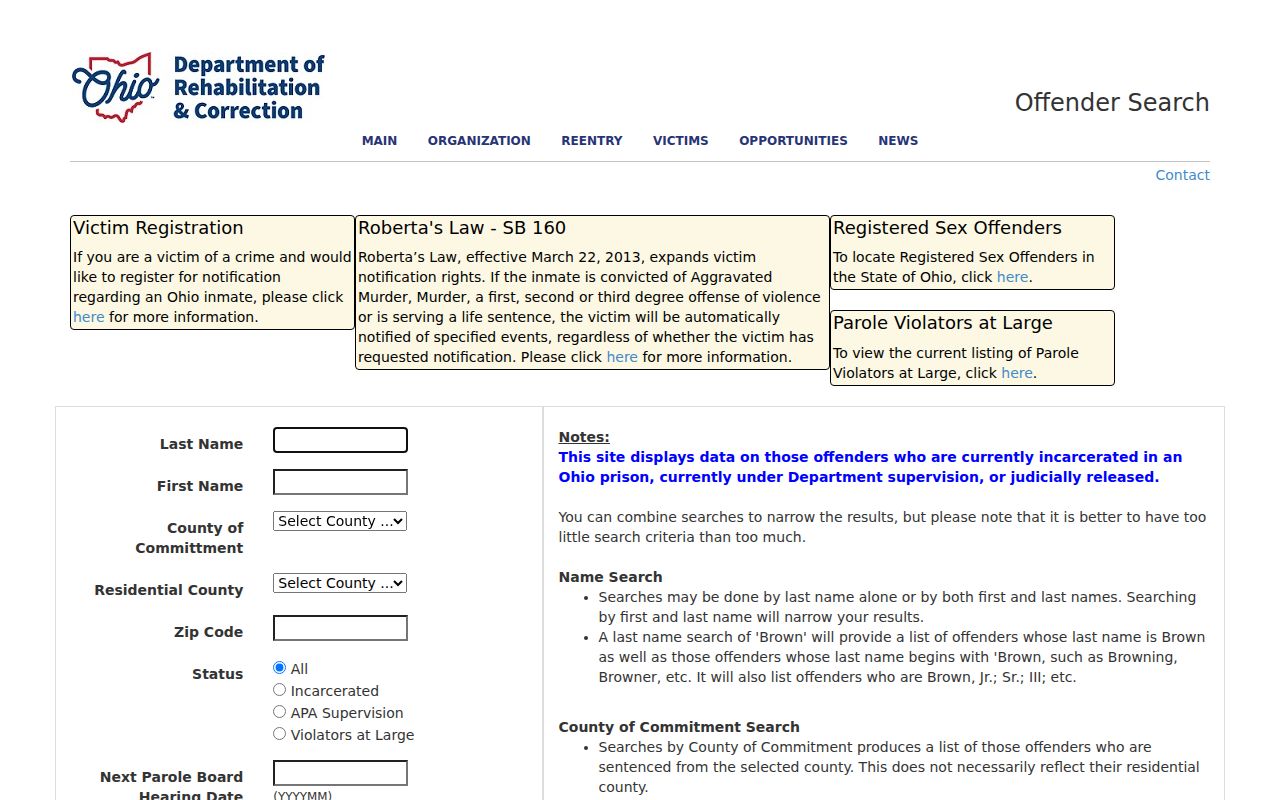
Its fields cover people incarcerated, under DRC supervision, or judicially released. It is not a Montgomery County jail roster, a complete criminal history, or proof of where someone lives now.
Note: A court or corrections result should be read only for the status and scope that the named official custodian publishes.
Centerville Resident Vital Checks
Vital records verify events, not a person’s whole life. Ohio Revised Code Chapter 3705 governs the copy process. Public Health–Dayton & Montgomery County Vital Statistics supplies Ohio birth records from 1908 and death records from 1909, with deaths keyed to the place of death. Its local office is at 117 S. Main St., Dayton, and accepts online, mail, and in-person orders. Its certified-copy form has fields for the event name, date, city or county, parent names, contact and mailing information, signature, and requested number of copies.
The local office lists each certified copy at $23; birth records normally become available seven to ten business days after registration. The death Social Security number option needs one of the authorized roles and identification. Marriage records follow a different route: Montgomery County Probate Court’s online index covers licenses issued after January 1, 2001, while earlier records are held at court premises. Marriage certified copies are listed at $2 each by mail or in person. Divorce records remain a court-copy matter, although the Records Center & Archives holds divorces from 1876 to 1949.
Montgomery County Probate Court’s marriage search is the official index route for eligible marriage-record research.
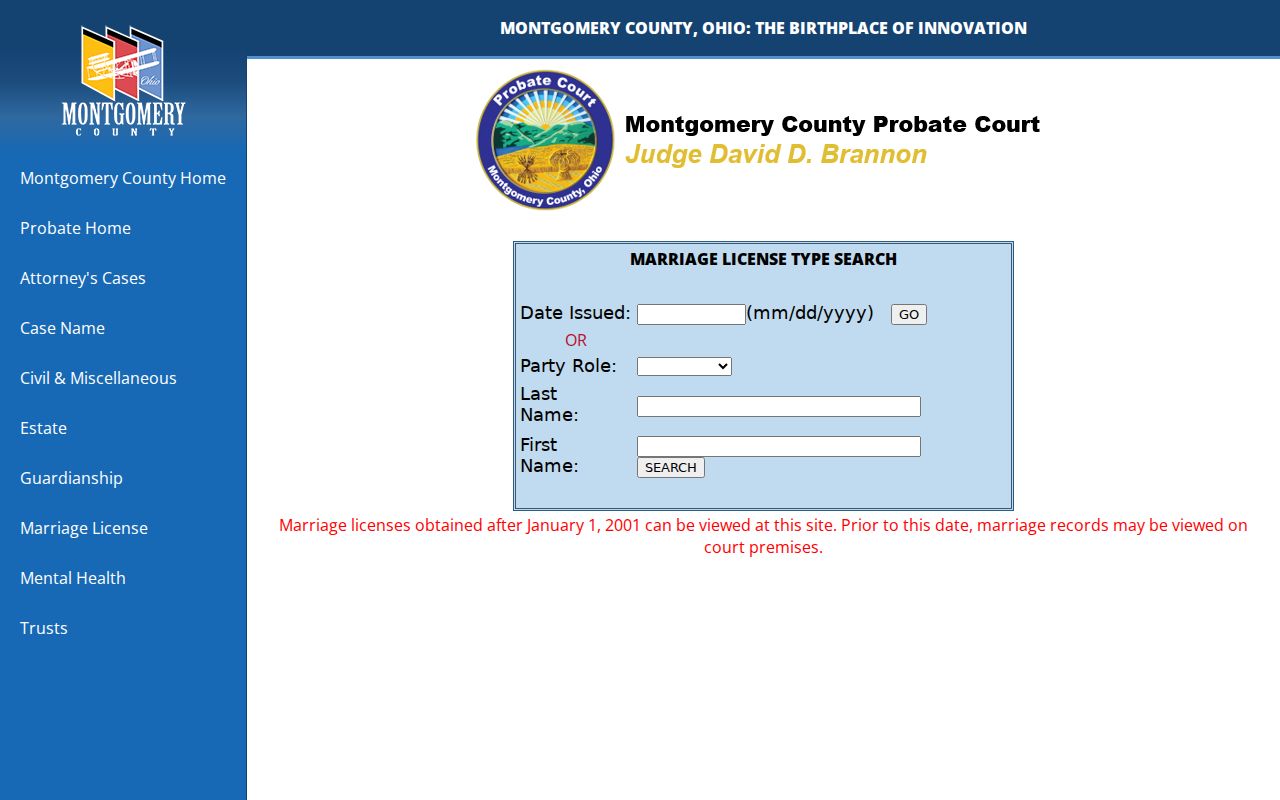
The form searches by date issued, party role, last name, and first name. A matching index result supports a request to the Probate Court; it does not justify publishing restricted information.
Centerville Resident Voter Lookup
The official Ohio Voter Lookup is a current-registration cross-check for an individual, not a browseable neighborhood list. Its required search fields are first name, last name, and county, with Montgomery selected for a Centerville search. A street-name dropdown appears only to narrow a broad match. The state’s search tips also point to a prior Ohio address, a derivative first name, or a former surname when a record is difficult to find.
ORC 3503.153 provides for a statewide web interface with specified elector information, subject to its exceptions. Separate safeguards protect driver-license and state-ID numbers, the last four digits of Social Security numbers, phone numbers, email addresses, confidential-voter data, protected-worker redactions, and other barred fields. Ohio does not use a partisan registration field, so none should be inferred. The Montgomery County Board of Elections is the local custodian for a permitted voter-file question or a current portal issue.
Centerville Resident License Clues
When two people share a name, a professional credential or entity filing can provide a limited way to separate them. Ohio eLicense may show the licensee’s name, status, board, license type and number, issue, effective and expiration dates, city, state, country, board-action indicator, and endorsements. A contractor lookup permits license type, credential number, first and last names, maiden name, state, and county. These fields describe a credential record, not a personal address.
The Ohio Secretary of State business search is similarly narrow. It is for entity filings and statutory-agent information. The Secretary of State does not maintain ownership or officer lists, so an agent or registrant hit is an affiliation or contact clue, not proof that the person owns a business or lives in Centerville. Compare any credential or entity result to a dated property, court, voter, or Recorder record before treating it as the same person.
Ohio eLicense verification is the official starting point for a credential check.
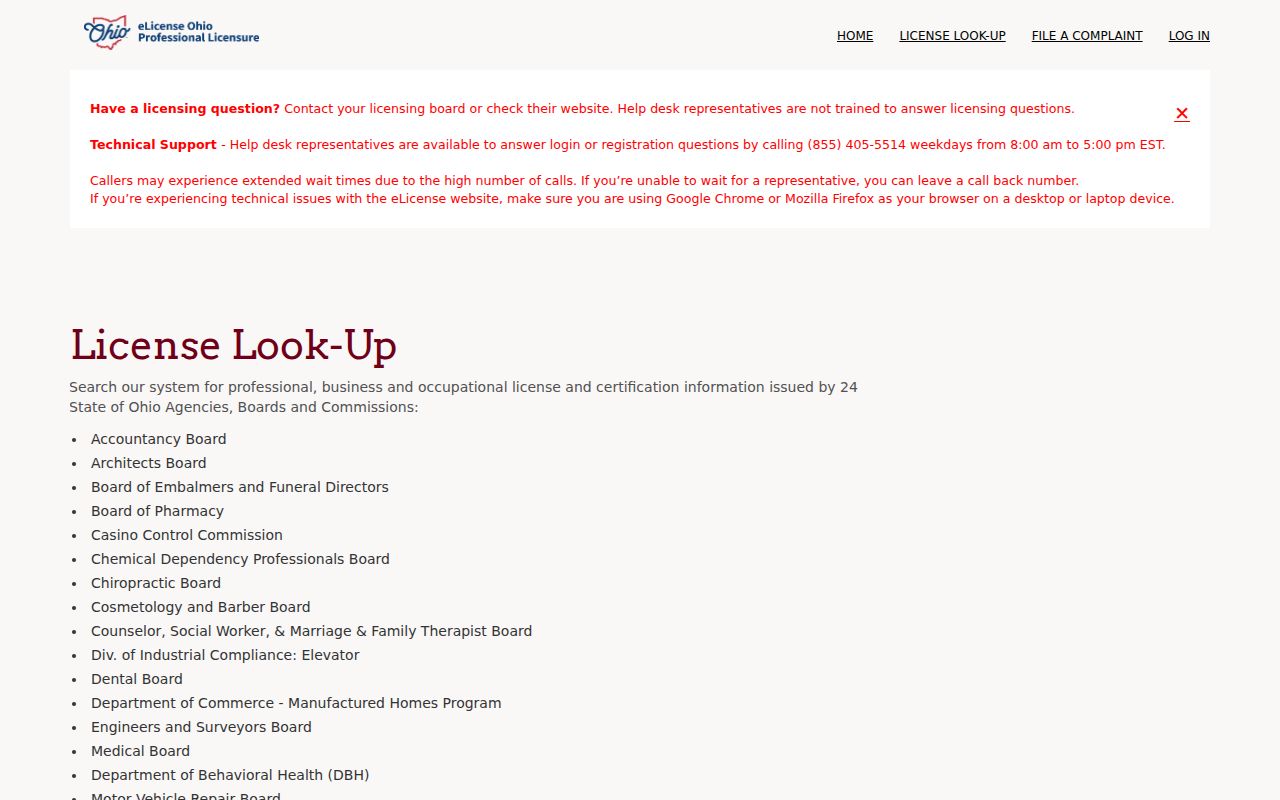
The result fields can narrow a name search to the board and credential at issue. They do not convert a license record into a resident record.
Centerville Resident Lookup Boundaries
Ohio’s Public Records Act, ORC 149.43, allows inspection of many existing public records and copies at cost, but exemptions and record-specific laws still control. Safe at Home participants can receive address confidentiality under ORC 111.41 through 111.47. Court restrictions, voter protections, vital-record limits, and the federal Driver’s Privacy Protection Act also place real boundaries around the public trail. Never treat an absent result as a reason to piece together protected details from other sources.
For an old or unclear result, go back to the keeper of the record: the Recorder for an instrument or book reference, the Auditor for parcel data, the Board of Elections for an allowed voter-file question, the court clerk for a docket or file, the Probate Court for an estate or marriage record, and the local registrar or state office for vital copies. The Records Center & Archives is the historical fallback when online material does not reach the needed era. A specific request should name the record category and time period.